
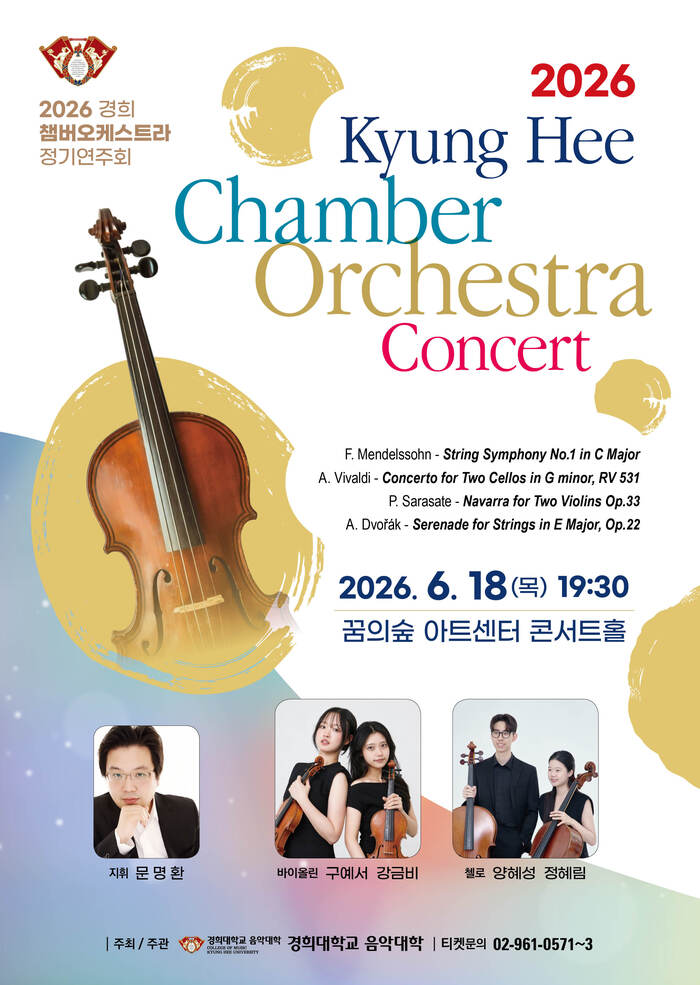
Kyung Hee Chamber Orchestra Regular Concert
Showtimes
Thursday (19:30)
Cast
Moon Myung-hwan, Koo Ye-seo, Kang Geum-bi, Jung Hye-rim, Yang Hye-sung, etc.
Synopsis
[PROGRAM] F. Mendelssohn - String Symphony No. 1 in C Major Felix Mendelssohn was a composer who displayed remarkable musical talent from a young age, actively composing symphonies and chamber music works by the age of twelve. String Symphony No. 1 in C Major is the first work in his series of string symphonies composed at a young age; while grounded in the Classical style, it reveals the elegance and vitality characteristic of Mendelssohn's later works. A bright and cheerful energy flows throughout the piece, and amidst the influences of Mozart and Haydn, the young composer's free imagination and delicate sensibility are evident. In particular, the transparent timbre characteristic of string instruments, fast passages, and lively rhythms harmonize to add vitality to the work. Despite being an early work by a young composer, it contains a highly complete structure and rich musical ideas, and is regarded as a piece that foreshadows Mendelssohn's genius. A. Vivaldi - Concerto for Two Cellos in G minor, RV 531 Antonio Vivaldi is a representative composer of the Baroque era who captured the dazzling virtuosity and dramatic contrasts of instruments in his music through numerous concertos. *Concerto for Two Cellos in G minor, RV 531* is a unique work featuring two cellos as solo instruments and is a representative repertoire that clearly demonstrates the charm of the Baroque concerto. This piece is characterized by a structure in which the two cellos engage in a dialogue and cooperation as if competing with one another. At times, they exchange melodies filled with tension, and at other times, they form beautiful harmonies to create a deep resonance. In particular, the warm and lyrical timbre characteristic of the cello stands out in the slow movements, while in the fast movements, agile passages and energetic rhythms leave a strong impression on the audience. It is a work that maximizes the charm of the two cellos amidst the splendor and sophistication characteristic of the Baroque era. P. Sarasate - Navarra for Two Violins Op.33 Pablo de Sarasate was an outstanding violinist and composer, well known for his works that capture the unique passion and dazzling virtuosity characteristic of Spain. Navarra is a work for two violins that embodies the vibrant folk atmosphere of the Navarra region in northern Spain. From beginning to end, the piece features lively rhythms and brilliant violin virtuosity, generating joyful energy and passion through the melodic interplay between the two performers. Dance-like rhythms and distinct Spanish colors are strongly evident, maintaining a light and bright atmosphere even amidst fast passages and flashy technique. The close interplay and brilliant ensemble created by the two violins are a major attraction, making this a work that offers intense pleasure to both the performers and the audience. P. Sarasate - Navarra for Two Violins Op.33 A. Dvořák - Serenade for Strings in E Major, Op. 22 Antonín Dvořák’s Serenade for Strings in E Major, Op. 22 is one of the representative works of string ensemble music, beloved for its warm and lyrical melodies. Dvořák naturally incorporated the sentiments of Czech folk music into his works, and this piece is notable for its rich melodic beauty and human warmth. Composed of five movements, this serenade possesses an overall peaceful and bright atmosphere, with each movement displaying its own distinct charm. Elegant waltz-style melodies, a soft and lyrical flow, and lively, folk rhythms harmonize to enrich the entire work. In particular, it effectively utilizes the deep and soft resonance of string instruments to convey warm sentiment, making it a piece where one can experience Dvořák’s unique, sincere, and beautiful musical world.
About the Show
Nearby Stays
Recommended stays found around the venue