
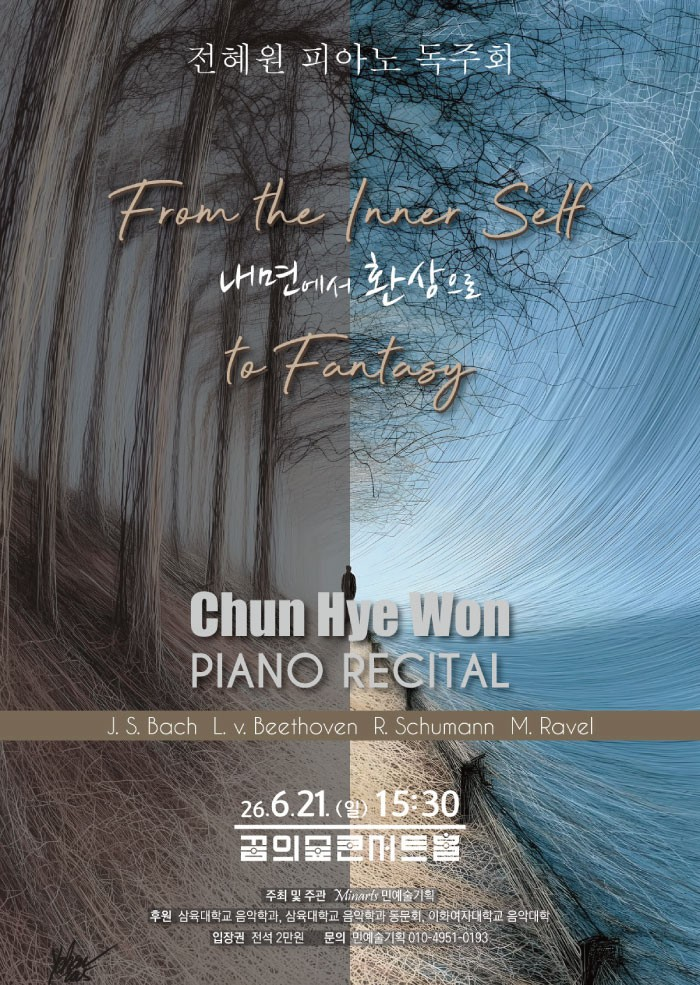
Jeon Hye-won Piano Recital
Showtimes
Sunday (15:30)
Cast
Jeon Hye-won
Synopsis
[Program] J.S. Bach - Prelude and Fugue in G minor, BWV 861 Included in Volume 1 of *The Well-Tempered Clavier*, this work harmonizes Bach's characteristic rigorous counterpoint with deep emotion. The Prelude captures tension and subdued sentiment within gently flowing melodic figures, delicately unfolding the dark tones typical of the minor key. The ensuing Fugue gradually builds cohesion through a clear theme and intricate voice progression, revealing both inner tragedy and intellectual structural beauty. Overall, it is a work where one can feel deep contemplation and sublimity amidst restrained emotion. L.v.Beethoven - Piano Sonata No. 27 in E minor, Op. 90 This work captures the characteristics of the transition period from the middle to the late era, condensing deep emotion and experimental composition within a concise form. Structured in two movements, this sonata creates a strong contrast between the first movement, with its intense and unsettling atmosphere, and the second, which is soft and lyrical, almost singing. In particular, the final movement evokes a sense of tranquility and inner reconciliation amidst a ceaselessly flowing melody, foreshadowing the spirituality and lyricism characteristic of late Beethoven. It is regarded as a work where delicate expression and profound interpretation are more important than dazzling virtuosity. R. Schumann - Carnaval, Op. 9 This piano suite, subtitled "Little Scenes on Four Notes," vividly portrays the fantastical atmosphere of a masked ball. Each piece is composed in the form of a short character miniature, musically depicting Schumann himself, his lover Clara, his friends, and figures of Commedia dell'arte. Throughout the work, the "A–S–C–H" pattern serves as a central motif to create a sense of unity, while being deeply imbued with poetic imagination and literary sensibility. It is a representative work of Schumann's early piano music, where splendor and delicacy, humor and introspection intersect. M. Ravel - Le tombeau de Couperin, Part III: Forlane This piece is a modern reinterpretation of the Baroque court dance, Forlane. Subtle dissonances and delicate colors are added to elegant and restrained rhythms, creating a coexistence of classical formal beauty and Ravel's signature Impressionistic sound. While it sounds like a light and sophisticated dance on the surface, the melancholy and tension permeating throughout leave a deep, lingering resonance. Particularly important for its flowing melodies, exquisite pedal technique, and transparent timbre, this work beautifully demonstrates Ravel's characteristic refined sensibility and French elegance.
About the Show
Nearby Stays
Recommended stays found around the venue