
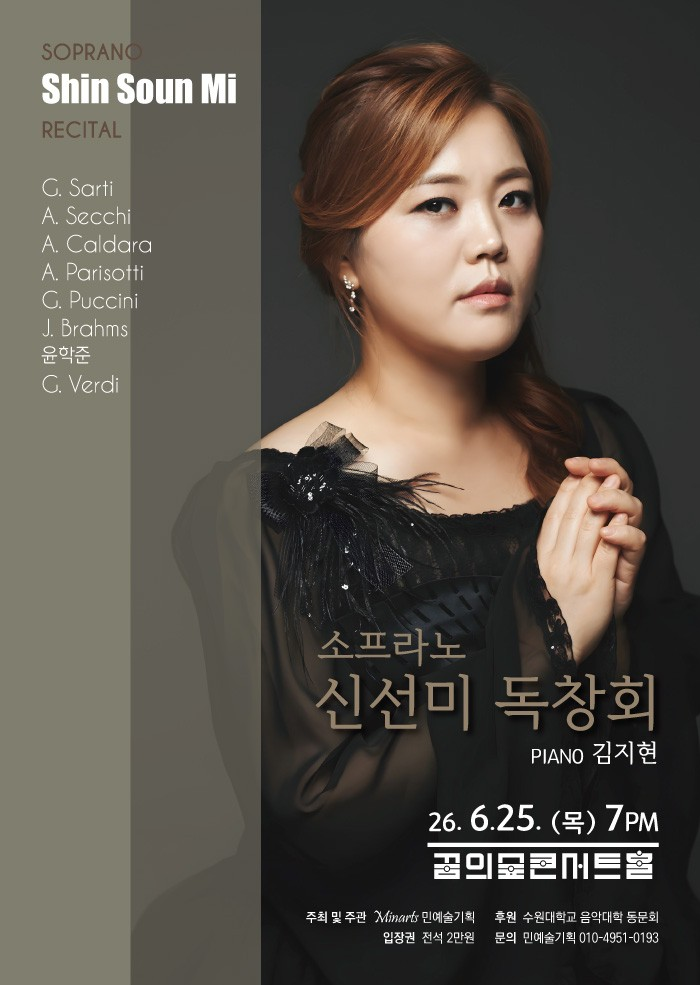
Soprano Shin Seon-mi Recital
Showtimes
Thursday (19:00)
Cast
Shin Seon-mi, Seong Yeo-rin, Ryoo Seung-wan, Kim Ji-hyun
Synopsis
[Performance Introduction] <G. Sarti - Lungi dal caro bene> This is a representative art song by the Italian composer Giuseppe Sarti, a work that delicately expresses the deep longing and pain felt when separated from a loved one. Composed of a relatively simple structure and lyrical melody, the piece requires breath control, phrasing, and emotional delivery rather than flashy virtuosity. Due to these characteristics, it is frequently used by vocal beginners to cultivate their musical expressiveness, while simultaneously offering room to create diverse moods depending on the performer's sensitivity and interpretation. The lyrics capture the earnest longing for a loved one and the pain of separation, showcasing the elegance and restrained sentiment characteristic of Italian art songs from the Classical era. <A. Secchi - Lungi dal caro bene> This work delicately portrays the longing and pain stemming from parting with a loved one. Due to long-standing confusion regarding the composer, this piece was widely known as a work by Giuseppe Sarti; however, it is transmitted through editions published under the name Secchi. Musically, a lyrical melody flows over a simple and balanced structure, with a focus on natural breath and emotional expression rather than excessive virtuosity. The lyrics capture the poignant longing for a distant lover and inner solitude, and depending on the performer's interpretation, they can express a wide range of emotions, from composure to deep sorrow. Due to these characteristics, it is one of the representative Italian art songs frequently covered in vocal education. <A. Caldara - Sebben crudele mi fai languir> A representative vocal piece by the Italian Baroque composer Antonio Caldara, it contains themes of confessing unchanging affection even amidst the coldness of a loved one. The piece is characterized by repeating melodies over a simple yet balanced structure, clearly demonstrating the restrained beauty and clear form of the Baroque style. In particular, since the same lyrics are repeated while subtle emotional shifts must be expressed, the performer's phrasing and dynamic control are crucial. Rather than flashy virtuosity, it requires stable breath control, a clear tone, and the delicate delivery of emotion; it is frequently used by vocal novices to build a musical foundation. The lyrics capture a faithful heart that refuses to give up love despite the lover's cruelty, making it a work where deep sentiment can be felt even within a simple melody. <A. Parisotti - Se tu m'ami Se tu sospiri> This is a song compiled and published by the Italian musician Alessandro Parisotti, a lyrical love song based on the Baroque style. Although this piece was long known as a work by Giovanni Battista Pergolesi, it is considered highly likely that Parisotti actually arranged or composed it. The music is characterized by soft melodies flowing over a simple and balanced form, and by the restrained expression of emotion. The lyrics demand true love and an unchanging heart from a lover, containing an appeal for the other person to understand her pain if their affection is sincere. Rather than excessive technique, natural breathing and delicate phrasing are important; it is a representative Italian art song frequently used in vocal education to cultivate basic expressiveness and musicality. <G. Puccini - Tosca Duet “Mario, Mario, Mario!”> This duet appears in Act 1 of the opera Tosca and is a scene that clearly demonstrates the dramatic and lyrical expression characteristic of composer Giacomo Puccini. The piece begins with the protagonist Tosca calling out to her lover Cavaradossi, capturing the complex emotions of the two lovers intersecting with Tosca’s jealousy. The music is composed of melodies that flow naturally like a conversation and rich harmonies, vividly expressing the characters' psychology within the flow of the drama. In particular, Tosca’s emotions—love, anxiety, and suspicion—are revealed through rapid shifts, while Cavaradossi gently soothes her, making the relationship between the two characters even more three-dimensional. This duet is regarded as a scene of high dramatic completeness, as it transcends a simple love song and contains a tension that foreshadows the tragedy to come. <J. Brahms - Liebestreu> Composed by the German composer Johannes Brahms, this is a lyrical work themed around the fidelity and devotion of love. Set to a poem by the poet Robert Reinlick, the piece conveys the message that true love remains unchanged amidst any trials or temptations. The music is based on simple yet profound harmonic progressions and a stable structure, characterized by an inner resonance that gradually intensifies within restrained emotional expression. In particular, the repeating melody and accompaniment flow as if symbolizing the steadfastness of love that continues ceaselessly, requiring the vocalist to deliver delicate phrasing, long breaths, and profound emotion. Rather than flashy technique, interpretation that conveys meaning within the flow of the music is important; it is one of the representative German art songs that best demonstrates Brahms's characteristic warm yet profound sentiment. <J. Brahms - Von ewiger Liebe> One of the representative art songs by the German composer Johannes Brahms, this work dramatically portrays the eternity and devotion of love. The lyrics are taken from the folk poetry collection *Des Knaben Wunderhorn*, and through the conversation between two lovers walking at night, the anxiety and certainty regarding love are revealed in contrast. The first half of the piece begins by expressing the woman's anxious state of mind with a dark and tense accompaniment, but as the piece progresses toward the second half, the music shifts to a bright and energetic tone, emphasizing the man's firm declaration of love. This dramatic contrast clearly demonstrates Brahms's characteristic meticulous structure and deep emotional expression. The vocalist must persuasively convey a wide vocal range, strong dynamic changes, and a narrative flow; this is a work that demands a dramatic interpretation beyond mere lyricism. <Yoon Hak-jun - Majung> A representative Korean art song by composer Yoon Hak-jun, this piece captures the excitement and warm longing of waiting for and welcoming a loved one. This song is set to a poem by poet Heo Rim, effectively showcasing the unique lyrical beauty of Korean art songs through its understated yet profound sentiment. The music features a gradual build-up of emotion within a relatively simple structure, characterized by soft melodies and natural flow. In particular, the section leading to "Standing at the Crossroads Where You Come" delicately expresses the tension and anticipation of waiting, transitioning into a warm and bright atmosphere as the piece progresses toward the latter half. For the vocalist, it is crucial to convey the meaning of the lyrics through clear timbre and sincere expression rather than excessive technique. As a work that interprets the universal themes of love and waiting through Korean sentiment, this piece continues to be loved by many vocalists and audiences alike. <Yoon Hak-jun - I, One Flower Bloom> This is a Korean art song composed by Yoon Hak-jun to a poem by poet Jo Dong-hwa, conveying the message that a single person's small change and actions can send a positive resonance to the world. This work likens the existence and role of an individual to the image of a blooming flower, characterized by lyrics and melodies that are simple yet convey a deep resonance. Within a relatively simple and clear structure, the music gradually expands in emotion while maintaining a bright and warm atmosphere. Rather than excessive virtuosity, natural breathing and sincere expression are important, and the key is to clearly convey the meaning of the lyrics. In particular, as the piece progresses toward the latter half, sentiments of hope and conviction gradually intensify, delivering gentle inspiration and comfort to the listener. Widely loved for both choral and solo performances, this piece is one of the representative works of modern Korean art songs, frequently performed in educational settings and concerts. <G. Verdi - Aida Duet "Ciel mio Padre"> This duet appears in Act 3 of the opera Aida, a scene where composer Giuseppe Verdi’s dramatic expressiveness shines. Sung at the moment of reunion between Aida and her father, Amonasro, the piece centers on Aida’s inner conflict between her homeland and her love. The music begins with a tense introduction and gradually builds dramatically as the father's persuasion and the daughter's anguish intersect. Amonasro attempts to obtain information for the sake of his country, while Aida falls into deep conflict as she faces the dilemma of having to betray her lover, Radames. This clash of emotions is vividly expressed through strong dynamic contrasts and melodic shifts. Vocally, it requires a wide vocal range and dramatic expressiveness; it is a crucial scene that must go beyond mere lyricism to persuasively convey the characters' psychology and drama.
About the Show
Nearby Stays
Recommended stays found around the venue